- Last Update21-Jun-2026


- Tweet
-
Jordan Silos records JD20m revenue as Kingdom strengthens food security reserves
The Jordan Times
AMMAN — The Jordan Silos and Supply General Company generated around JD20 million in sales and service revenue in 2025, while transferring JD3 million to the Treasury as a financial surplus and paying nearly JD304,000 in taxes and national contributions.
The company announced the figures during its annual ordinary general assembly meeting, which Board Chairman Anwar Ajarmeh chaired in the presence of board members, General Manager Emad Tarawneh and shareholders representing 100 per cent of the company's shares.
Shareholders approved the company's 2025 annual report, financial statements and external auditor's report. The company reiterated its role in managing Jordan's strategic grain reserves and supporting the Kingdom's food security system.
Established under Cabinet Decision No. 657 in 2000, Jordan Silos serves as the storage arm for strategic reserves of grains and essential food commodities in line with the Ministry of Industry, Trade and Supply's policies, according to the Jordan News Agency, Petra.
The company's results come as Jordan continues to strengthen food security measures amid regional tensions and uncertainty surrounding global supply chains.
The Ministry of Industry, Trade and Supply told The Jordan Times, Kingdom maintains strategic reserves of wheat and barley at safe levels under a precautionary food security policy designed to secure supplies of essential commodities.
The ministry's spokesperson said available wheat stocks can meet domestic demand for more than 10 months, while barley reserves are sufficient for more than nine months, placing Jordan among the countries with the highest reserve coverage levels globally.
The spokesperson also said developments in the Strait of Hormuz do not affect Jordan's wheat and barley imports because the Kingdom does not use the waterway to source either commodity.
Jordan's total grain storage capacity stands at around 2.25 million tonnes, one of the largest capacities in the region, enabling the Kingdom to maintain strategic reserves during both normal and emergency conditions, according to the ministry.
The ministry said its food security strategy focuses on diversifying import sources, increasing reserve levels, modernising and expanding storage infrastructure, supporting local wheat and barley production, and broadening shipping routes and supply channels.
Food security expert Fadel El Zubi recently told The Jordan Times that Jordan's wheat security remains strong despite the Kingdom's heavy dependence on imports.
"Jordan's wheat security is, in truth, a quiet success. The shelves are safe, the reserves are deep, and the country has avoided the panic that often accompanies global food crises," El Zubi said.
He noted that Jordan imports around 97 per cent of its wheat requirements but maintains reserves that cover between five and eight months of consumption, providing flexibility during periods of global market volatility.
El Zubi argued that the main challenge lies in the financial cost of maintaining food security rather than in the availability of supplies.
"The danger is not empty shelves, but a strained Treasury and rising foreign currency costs," he said, referring to the cost of maintaining strategic reserves and bread subsidies during periods of elevated global commodity prices.
He also highlighted the economic impact of food waste, citing estimates that around 34 per cent of Jordan's wheat supply is lost or wasted along the value chain at an annual cost of about $105 million.
"Every percentage point of wheat waste reduced simultaneously eases the import bill, lowers subsidy expenditures and relieves foreign exchange pressures," El Zubi said.
He called for measures that would strengthen the long-term sustainability of Jordan's food security system, including reducing food waste, expanding private sector participation in grain storage, diversifying suppliers and reforming subsidy mechanisms.
As Jordan works towards expanding its strategic reserves in the coming years, policymakers face the challenge of balancing strong food security buffers with the financial cost of sustaining them.
Latest News
-
 Iran confirms it has signed deal with US: foreign ministry spokesman
-
 Hegseth tells NATO US will review force presence in Europe
-
 G7 leaders welcome Trump 'change' on Ukraine
-
 Safadi, Slovenian counterpart discuss cooperation, regional developments
-
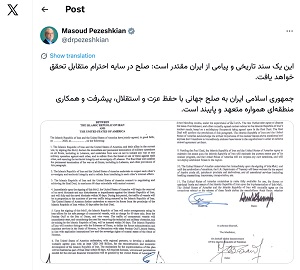 Pezeshkian publishes Iran’s copy of reported US agreement