- Last Update22-Jan-2026


- Tweet
-
Royal meetings: A Hashemite approach to strengthening national communication - By Hasan Dajah, The Jordan Times
Royal meetings with tribes, governorates, villages, rural communities, and refugee camps, as well as with various segments and components of Jordanian society in the Hashemite Kingdom of Jordan, are among the most prominent features of the Hashemite approach to governance and one of the most effective tools for establishing direct communication between the leadership and the people.
His Majesty King Abdullah has consistently promoted a culture of closeness to citizens and a commitment to listening to them in their communities, stemming from a firm conviction that the strength of the state derives from the cohesion of its society and that genuine development can only be achieved through a deep understanding of people's realities and actual needs. Over the decades, these meetings have formed a deeply rooted political and social tradition that reflects the unique nature of the Jordanian experience in governance and affirms that the Hashemite leadership is always present alongside the citizen, close to their daily concerns, and responsive to their issues, regardless of their geographical or social location.
These meetings encompassed various regions of the Kingdom, from south to north, clearly demonstrating the comprehensiveness of the King's vision and the equitable nature of his attention. His Majesty visited Aqaba Governorate, Jordan's economic gateway, and met with the residents of Wadi Rum, a symbol of the southern desert and its heritage.
The meetings also included the governorates of Ma'an, Tafila, and Karak, representing profound historical and national significance, and extended to Madaba and Amman, two important centers of political and administrative life. His Majesty did not neglect the northern governorates, visiting Mafraq, Jerash, and Ajloun, culminating in the final meeting in Irbid Governorate. This underscores that all regions of Jordan receive attention and follow-up, and that the concerns of citizens in every corner of the country are a constant priority in the Hashemite approach.
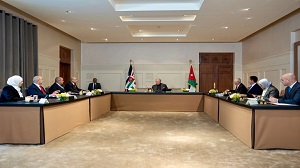
These meetings stem from a firm vision based on direct human connection, free from official barriers and rigid protocols. King Abdullah is committed to ensuring that the relationship with citizens is founded on closeness and mutual respect, not on formal distance. In these meetings, His Majesty sits with tribal leaders, representatives of the governorates, and residents of villages and rural areas in an atmosphere akin to family gatherings, characterized by frankness and clarity, and providing an open space for genuine dialogue without formality or constraints. Citizens find themselves before a leadership that listens attentively, discusses objectively, and values honest opinions, however critical or challenging they may be.
These meetings offer ample opportunity to express demands and needs, whether related to essential services such as health, education, and water, or to issues of unemployment and job creation, or to the development of infrastructure and local development projects. The importance of this space extends beyond simply presenting problems; it involves citizens in identifying solutions and setting priorities, thus strengthening the sense of shared responsibility towards the nation.
These meetings also contribute to consolidating the values of participation and belonging, and affirming that every individual, regardless of their position, is a true partner in the process of building and modernization, and that their voice is an integral part of the national decision, which deepens the trust between the leadership and the people, and strengthens the internal front of the state.
These royal meetings carry profound national significance that transcends mere direct communication. They clearly underscore the historical and pivotal role played by Jordanian tribes in building the modern state, safeguarding its security and stability, and solidifying the values of loyalty and belonging. These meetings also reflect the Hashemite leadership's appreciation for the status of villages and rural areas as an integral component of Jordanian national identity and a fundamental source of resilience and contribution.
The particular attention given to the desert regions embodies the leadership's awareness of the importance of these areas, which throughout history have formed the social and geographical heartland of the nation, and whose people have contributed to the defense and service of the homeland in the armed forces, security services, and various fields of national work.
Through these meetings, King Abdullah reaffirms that development cannot be genuine unless it is comprehensive and balanced, its benefits reaching all corners of the Kingdom as well as its center, and taking into account the unique characteristics and needs of each region. These meetings are not limited to listening and diagnosing issues; rather, they translate into clear royal directives for the government and relevant institutions.
These directives aim to follow up on demands and work towards their implementation within available resources and with a sense of responsibility. In this context, the role of the Royal Hashemite Court stands out as an effective link between citizens and state institutions. This is achieved through continuous field visits to governorates, villages, and rural areas, conveying the King's directives, listening to people's concerns, and monitoring the implementation of decisions on the ground. This strengthens mutual trust and reinforces the principle of a state close to its citizens.
These meetings contribute to strengthening national unity and consolidating the concept of social justice. Citizens, wherever they may be, feel that their voices are heard and that the leadership is monitoring their circumstances without discrimination. Furthermore, these meetings reflect an advanced model of political administration, based on combining central leadership and a comprehensive vision on the one hand, with attentiveness to local details on the other. This aligns with the state's direction towards strengthening decentralization and empowering local communities to express their priorities.
From a social perspective, these royal meetings embody the spirit of the unified Jordanian family, where political values intertwine with social values based on respect, solidarity, and direct communication. This approach has contributed to consolidating political and social stability, making Jordan a model of balanced relations between leadership and the people, especially in light of the regional and economic challenges facing the region.
Ultimately, these royal meetings with tribes, governorates, villages, and Bedouin communities are not merely protocol occasions, but rather a deeply rooted practice reflecting a philosophy of governance based on partnership, listening, and shared responsibility. They are a genuine expression of the Hashemite leadership's commitment to serving the citizen, promoting comprehensive development, and preserving national unity, thus ensuring Jordan's steady and confident progress toward the future.
Hasan Dajah — Professor of Strategic Studies at Al-Hussein Bin Talal Universit
Latest News
-
 Trump Continues Inviting Countries to Join “Peace Council”
-
 Jordan condemns Israel’s demolition of UNRWA buildings in Jerusalem
-
 Trump says not thinking 'purely of peace' in Greenland push
-
 Talks between Damascus, Kurdish-led forces 'collapse': Kurdish official
-
 King meets with House of Representatives’ permanent office