- Last Update04-Dec-2025


- Tweet
-
Israel’s Syria raid shows high cost of lawless power - By Michael Jansen, The Jordan Times
The joint operation between the Syrian army and US forces to destroy Daesh arms dumps in southern Syria marks a turning point in the campaign against the group. While the US has deployed 1,500 troops in northeastern Syria to battle Daesh along with Syrian Kurdish forces, joining the operation with Syria's regular army extends the US regional reach and strengthens the campaign to eliminate Daesh.
This alliance could become long-term if, as reported, the US instals military personnel at an airbase near Damascus. Such a deployment would mark the first direct US military presence in the Syrian capital and signal a shift in the regional balance of power following last December's ouster of Iran and Russia-backed Syrian President Bashar al-Assad.
The shift would be an important result of normalization between the year old Haya't Tahrir al-Sham (HTS) Syrian government and Washington. This was clinched last month when Syrian president Ahmed al-Sharaa met US President Donald Trump at the White House. This was the first ever visit by a Syrian leader since Syria gained independence nearly 80 years ago. Further cooperation can be expected as the US has suspended sanctions against Syria. Sharaa needs peace and quiet on the home front, a surge in humanitarian aid, and relief from sanctions to attract institutional and private investment in existential reconstruction and development.
However, this has not materialised due to the lack of strong central control, insecurity, economic meltdown and sectarian tensions. After the Assads were driven from power, the undermanned and weak Syrian army melted away, leaving the limited number of fighters belonging to HTS and its allies to tackle a range of militia groups and criminals. Negotiations to merge US-backed Kurdish fighters - who occupy 25 per cent of the country in the northeast - with those of HTS have not borne fruit so far. The Kurds seek regional autonomy which Damascus rejects, aware that this would weaken Damascus’ central control over the entire country.
Uncertainty has been exploited by Israel which has sent troops into the UN buffer zone between Israel and Syria and mounted multiple operations to capture "wanted men" in Quneitra province and near Damascus.
Of the 25.6 million Syrians, there are seven million displaced within Syria and another six million living in neighboring countries and further afield, of whom 1.2 million have returned home. Millions of children are out of school, the health system has collapsed, and medicine is in short supply. Electricity can be one or two hours out of six, 10 or 24 hours, depending on location. More prosperous households depend on solar panels mounted on rooftops. Syrians without proper shelter face winter cold and rain without adequate protection.
Amnesty International said that the new authorities in Syria have demonstrated commitment to reform, transitional justice and reconciliation but argued that democracy has not been installed. On her return from Syria, Amnesty's Secretary General Agnes Callamard told the Associated Press, "“All of those things are very good signs, but they are not very deep.” She was critical of the international community which has ignored the changes taking place in Syria.
Last month, Syria held elections for an interim parliament, but the Syrian people did not cast ballots. Two-thirds of the 210-member assembly seats were chosen through province-based electoral colleges, with seats distributed by population representation, while one-third will be appointed directly by Sharaa. This parliament will serve for only 30 months while a new constitution is adopted, and preparations are made for fresh elections.
Since HTS assumed power a year ago, Israel has conducted repeated air raids across Syria and staged ground incursions in its south. Israel has planted checkpoints in Syria and detained and disappeared Syrians. Israel has invaded the buffer zone that separated the two countries since they signed the 1974 disengagement agreement and established outposts around Jabal Sheikh (Mount Hermon), the highest peak in the region.
Last Friday, Israel invaded southern Syria with the declared aim of kidnapping three Syrians allegedly belonging to Jamaa al-Islamiyah, Lebanon’s branch of the Muslim Brotherhood. At least 13 Syrian civilians were killed and six Israeli soldiers wounded in the southern town of Beit Jinn on the edge of the Golan Heights when local people fought back. Syria’s representative to the UN Ibrahim Olabi said the attack exposes Israel’s dismissal of international law and reflects Israel's concern over developments in Syria. “Israel is terrified by a strong and prosperous and stable Syria. We are heading in that direction no matter what,” he stated.
Latest News
-
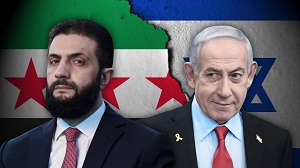 Netanyahu open to deal with Syria but insists on strict security conditions
-
 Race to get aid to Asia flood survivors as toll tops 1,200
-
 Pope Leo to honor Beirut blast victims with silent prayer at port
-
 Trump optimistic after Ukraine talks as Rubio says 'more work' needed
-
 Turkey's Erdogan calls Black Sea drone strikes a 'worrying escalation'