- Last Update08-Nov-2026


- Tweet
-
Crown Prince’s meeting with EU commissioner opens new horizons for Jordan’s digital economy — experts

The Jordan Times
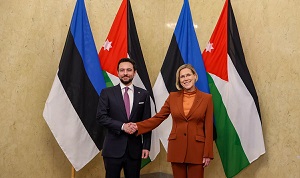
AMMAN — The meeting between HRH Crown Prince Hussein and European Commissioner for Startups, Research and Innovation Ekaterina Zaharieva on the sidelines of the Tallinn Digital Summit in Estonia could open new opportunities for Jordanian start-ups, researchers and technology companies to access European funding, investment and markets, economic experts said.
The meeting, held on Thursday, focused on strengthening cooperation in artificial intelligence, energy, healthcare and emerging technologies, as well as connecting Jordanian start-ups with European innovation ecosystems, according to a Royal Court statement.
The two sides also discussed potential cooperation programmes aimed at turning research and innovation into commercial ventures and establishing partnerships between Jordanian and European universities and research institutions.
Experts said that the discussions reflect the growing importance of innovation and technology in diversifying Jordan’s economy, creating quality employment opportunities and strengthening the country's competitiveness in international markets.
According to figures from the Information and Communications Technology Association of Jordan (int@j), the ICT sector employs more than 46,000 people, highlighting its contribution to the national economy and its potential for further growth.
Financial and economic expert Mohammad Sarhan said that the meeting's economic significance lies in translating Jordanian innovation into commercially viable projects capable of expanding into international markets, attracting investment and generating high-quality jobs for young people.
The challenge, he said, is no longer limited to developing skilled technology professionals, but also involves increasing the number of Jordanian companies capable of developing their own technological products and exporting them, rather than relying primarily on providing services to other markets.
Sarhan pointed to the comprehensive strategic partnership between Jordan and the European Union, supported by a €3 billion financial and investment package for 2025-2027, including approximately €1.4 billion earmarked for investment.
Although the package is not exclusively dedicated to innovation, it provides a broader framework for economic cooperation that could help Jordanian technology companies establish links with European investors and institutions, he said.
He also highlighted Horizon Europe, the EU's research and innovation programme, which has a budget of approximately €95.5 billion for the 2021-2027 period. The programme provides opportunities for universities, research centres and companies to participate in collaborative projects and access funding under established eligibility requirements.
However, Sarhan stressed the need for a national mechanism to help Jordanian researchers and businesses prepare competitive funding proposals and establish partnerships with European counterparts, ensuring that cooperation opportunities translate into tangible economic outcomes.
He also called for establishing specialised technology-transfer offices at universities to assess the commercial potential of research, protect intellectual property rights, connect researchers with investors and introduce clear revenue-sharing arrangements that encourage applied research.
The sectors discussed at the meeting, particularly AI, energy and healthcare, address practical economic challenges and offer opportunities to improve productivity and develop exportable solutions, Sarhan said.
AI applications, for example, could enhance business productivity and healthcare efficiency, while technologies related to energy and water management could address domestic needs and serve regional markets.
He added that investment should prioritise technologies capable of reducing operating costs and addressing specific production challenges, rather than pursuing global technology trends without clear economic benefits.
Sarhan also underlined the need for financing mechanisms suited to start-ups, noting that early-stage technology businesses face risks that make traditional bank lending less suitable.
He proposed partnerships between Jordanian and European venture-capital funds, early-stage financing programmes for promising projects and opportunities for local companies to test their products with European institutions before expanding commercially.
The success of such partnerships, he said, should ultimately be measured by the number of Jordanian companies entering European markets, the investment they attract, the commercial returns generated by research and the quality of jobs they create.
He added that the Crown Prince's approach reflects the importance of shifting towards an economy based on producing and exporting knowledge and technology, increasing local value-added and expanding opportunities for young Jordanians to compete internationally.
Ihab Qadri, representative of the garments and textiles sector at the Jordan Chamber of Industry, said the meeting signals an effort to strengthen Jordan's position in the knowledge and innovation economy, which is increasingly important for economic growth, competitiveness and quality employment.
The technologies under discussion are no longer confined to specialised technology sectors, but are increasingly influencing the productivity and competitiveness of traditional industries, Qadri said.
He stressed that converting research and innovation into commercial projects remains a key challenge for Jordan's national innovation system.
Universities, research capabilities and start-up talent alone are insufficient without an integrated system linking scientific research to market and industrial needs, providing early-stage and experimental funding, protecting intellectual property and helping companies test products and access international markets, he said.
Qadri said that cooperation with European institutions should focus on joint research and development projects involving universities and businesses, incubating technology-based projects that address challenges in industry, energy, healthcare and services, and facilitating Jordanian companies' access to European partners and investors.
He added that the impact of such cooperation should not be assessed solely by the number of start-ups established, but also by their ability to survive and expand, the volume of knowledge-based exports they generate, the jobs they create and their contribution to national productivity.
These priorities are consistent with the objectives of Jordan's Economic Modernisation Vision, he said.
Economic expert Wajdi Makhamreh echoed these views, saying that the focus on AI and emerging technologies reflects Jordan's efforts to diversify its productive base beyond traditional economic sectors.
AI is already contributing to higher productivity, lower operating costs and new business opportunities, while connecting Jordanian start-ups with European innovation ecosystems could provide access to wider markets, investor networks, venture-capital funds and European financing programmes, Makhamreh said.
Such links could help local companies expand beyond the domestic market, attract investment and strengthen their regional and international competitiveness, he added.
Makhamreh also identified the commercialisation of research as a major gap in Jordan's innovation ecosystem.
Although the Kingdom has universities, scientific expertise and qualified young people, stronger links are needed between academic institutions and the private sector to encourage the commercial application of research, establish technology companies, register patents and turn innovations into exportable products and services, he said.
He added that the Crown Prince's meeting with the European commissioner comes within the broader framework of the Jordan-EU strategic partnership and its €3 billion support and investment package for 2025-2027.
Cooperation in research and innovation could provide an additional channel for maximising the economic benefits of the partnership, particularly by connecting Jordanian talent and businesses with European expertise, financing and markets, Makhamreh said.
Latest News
-
 Crown Prince meets with Estonia PM
-
 Public Security mourns Corporal Jawad Al-Slayta, killed in terrorist knife attack
Al-Ghad
-
 Trump says ‘largely true’ Iran war caused midterms loss, after Vance comments
-
 Crown Prince meets with Estonia president in Tallinn
-
 'We did it!': Democrat El Sayed hails US Senate win amid blue 'tsunami'