- Last Update13-Sep-2026


- Tweet
-
Trump links Iran war to September 11 attacks as pressure on Tehran deepens
AFP
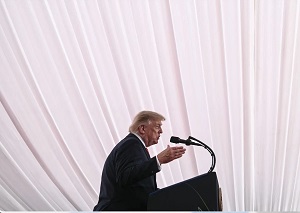
AMMAN — US President Donald Trump on Friday linked the war against Iran to the legacy of the September 11, 2001 attacks. He said Washington would continue working to prevent Tehran from obtaining a nuclear weapon.
Trump praised US service members who fought in the “war on terror” following the attacks. He said American forces were now working to ensure that Iran would “never ever have a nuclear weapon”.
The remarks came as the US-Israeli war on Iran entered its seventh month. Trump also criticised what he called domestic “fanatics”, in an apparent reference to his political opponents.
Iranian President Masoud Pezeshkian said US pressure on Iran had reached a “critical and dangerous stage”. He warned that continued economic pressure was worsening an already complex international situation, AFP reported.
Pezeshkian said the world was going through an “unprecedented” period of complexity. Speaking in India ahead of the BRICS summit, he said Iran had faced heavy sanctions for years, with pressure intensifying following US and Israeli military action, according to AFP.
The war began in late February with US and Israeli strikes on Iran. Tehran responded by restricting traffic through the Strait of Hormuz, a key route for global energy shipments.
The disruption pushed global energy prices higher. It also extended the economic impact of the conflict beyond Iran and the wider Middle East.
“When a country is subjected to political and military pressure on its trade, energy, infrastructure and financial system, the repercussions extend beyond its borders,” Pezeshkian said.
The conflict is also forcing other countries to consider their role in securing the strategic waterway. South Korea’s foreign minister told his Iranian counterpart on Friday that Seoul had made no decision on a possible military deployment to the Strait of Hormuz.
In remarks to The Jordan Times, political analyst Amer Sabaileh said Washington was increasingly framing Iran through the lens of terrorism and the September 11 attacks.
“This approach appeared to be part of a broader effort to isolate Tehran politically,” Sabaileh said.
“For the United States, all indications today point to Iran as the source of terrorism. There is a strong and logical link, from the US perspective, between Iran, the September 11 attacks and the role of Hizbollah,” Sabaileh said.
He said the focus on Iran was shifting from economic isolation towards removing political legitimacy from the Iranian system.
The nuclear issue, he added, was becoming another element in that process.
“Gradually linking Iran to terrorism, followed by the International Atomic Energy Agency’s scrutiny of its nuclear activities, means we are returning to the idea of isolating Iran, stripping it of legitimacy and also legitimising targeting it,” Sabaileh said.
Pezeshkian was in India for his first official visit and was due to hold talks with Prime Minister Narendra Modi ahead of the BRICS summit.
Latest News
-
 Trump promises Americans $5,000 if Republicans win Congress
-
 Macron urges Europe to develop 'crewed spaceflight' programme
-
 Russian strike on Ukraine shopping centre kills at least four
-
 Trump Says Iran War to End after US Midterm Elections, Threatens to Attack Pickaxe Mountain
-
 Safadi conveys King’s greetings to Al Sharaa, stresses Jordan’s support for Syria