- Last Update01-Oct-2026


- Tweet
-
Women in Politics Forum launched to promote dialogue, participation
The Jordan Times
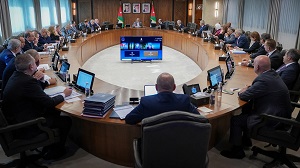
AMMAN — The Inter-Ministerial Committee for Women’s Empowerment (IMCWE) and the Ministry of Political and Parliamentary Affairs on Wednesday launched the Jordanian Women in Politics Forum (JWPF).
The JWPF’s aim is to be a space for dialogue, communication and exchange of information and experiences among female political parties’ members.
The initiative came from around 30 women from various political parties in the Kingdom who joined forces to establish the JWPF, said Nuha Muhreiz, one of the JWPF founding members.
“Hopefully make a real difference in the journey of Jordanian women towards effective political participation,” Muhreiz said.
She added that she hopes the forum will work as an inclusive national framework for dialogue, networking, and joint action—and as a new step reflecting the maturity of Jordanian women’s experience in political parties.
“We believe that women’s presence in political life should not be measured solely by the number of seats held by female members, but rather by their ability to influence decision-making, contribute to policy formulation, and lead change,” Muhreiz added.
She added, “Today, we stand at the threshold of a new phase: a transition from mere presence to making an impact, from representation to leadership, and from individual initiatives to organised institutional action”.
Minister of Social Development Wafa Bani Mustafa said that the forum is one of the outcomes of the Political Modernisation Vision that was initiated by His Majesty King Abdullah, which focused on increasing the participation of women and youth in political life.
The Political Modernisation Vision emphasises the need to engage young citizens and women in political public life, Bani Mustafa told the gathering.
“We strongly believe that the forum will strengthen women’s presence in political life,” said Bani Mustafa, who is also the Chairperson of the Inter-Ministerial Committee for Women’s Empowerment.
Bani Mustafa added, “We are hopeful that the forum will be a space where all women political party members will gather to work for the benefit of the nation and its citizens”.
Minister of Political and Parliamentary Affairs Abdul Moneim Odat also addressed the gathering during the two-hour event, saying the forum will hopefully allow female political parties members to exchange ideas, experiences and work towards increasing their presence in politics in the future”.
Odat added that he is hopeful that “the dialogue among these women will be done in a manner that will encourage respecting each other’s opinions and ideologies”.
Country Representative of UN Women Jordan Nicolas Burniat said in his opening speech that the JWPF stems from “many years of training and support provided by the Women Political School to women interested in a political career”.
The JWPF is meant as a space that brings together women from different political parties, different political currents and different parts of the political spectrum, the UN official said.
“That is important because women in politics do not, and should not, all think alike,” Burniat stressed.
The objective is to “make sure that women have a strong voice in politics, in all its diversity,” Burniat added.
Paolo Zingale, head of Cooperation at the European Union Delegation to Jordan, said the launch of the forum was a “timely and constructive initiative in Jordan’s political modernisation process”.
“Let me say clearly: supporting women’s political participation is not an external agenda. It is a Jordanian national priority, and the European Union is proud to support Jordan’s own vision in this regard,” Zingale told the gathering.
The EU’s support is neutral, and it is grounded in engagement with all parties, “regardless of ideology, in the shared interest of a more inclusive political life in Jordan,” Zingale added.
The EU official went further to stress that “women’s empowerment in politics must go far beyond just having a woman in the room”.
“Women must have a voice, and they must be able to engage fully on all issues, not only those narrowly defined as women’s issues, family issues, or children’s issues,” Zingale said.
Latest News
-
 Iran Says No New Talks Planned With US
-
 Crown Prince meets with US International Development Finance Corporation CEO
-
 Iran stands firm on Hormuz plan after US rejection
-
 Israeli minister calls for West Bank war, annexation of Lebanon, Gaza areas
-
 Prime minister orders closure of facilities selling tobacco to minors