- Last Update19-Apr-2026


- Tweet
-
Aqaba Railway project: a transformational venture for Jordan’s economy
The Jordan Times
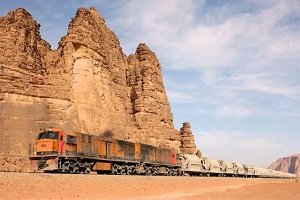
AMMAN — Jordan’s ambitious Aqaba Railway is not just a transportation initiative, it is a defining moment in the country's future economic growth, experts said, highlighting the mega project’s pivotal role in Jordan's broader economic strategy.
Prime Minister Jafar Hassan and UAE Vice President, Deputy Prime Minister and Chairman of the Presidential Court Sheikh Mansour Bin Zayed Al Nahyan on Wednesday witnessed the signing of agreements to launch the implementation of the Aqaba Port Railway project.
The landmark project involves the establishment of a joint Jordanian-Emirati company tasked with the construction and operation of the railway.
The venture is a 50-50 partnership between Jordan, represented by the Jordan Phosphate Mines Company, Arab Potash Company, the Government Investments Management Company, and the Social Security Investment Fund, and the UAE, represented by L'Imad Holding Company, the sovereign investment platform of the Abu Dhabi government.
The project is the largest of its kind in the Kingdom's history, with a total joint investment estimated at $2.3 billion.
Issam Qadamani, an economic expert said according to his article in Al Rai Newspaper that the project would have “immense” contributions to implementing Jordan’s broader development endeavour.
“Development in its holistic concept can only be based on large projects,” he said.
The Aqaba Railway Project, officials said not only promises to enhance local infrastructure but also positions Jordan as a crucial player in regional trade.
Prime Minister Jaafar Hassan has underscored that 2026 will be the year of major projects for Jordan, with a strong focus on large-scale initiatives like the Aqaba Railway.
“This government has spent a year preparing for these projects, and their titles, studies, and foundations have been accumulating for years,” he said.
Despite the challenges posed by geopolitical shifts, the railway is moving forward, Qadamani said, adding that such projects are vital because they create “new assets with great values owned by the state and traded through generations.”
The Aqaba Railway is set to be one of those assets, offering immense economic and strategic value to the country for years to come.
A central feature of the Aqaba Railway is its potential to integrate Jordan into a larger regional transport network.
Jordan’s Minister of Transport, Nidal Qatamin, said, “The railway will serve as the foundation for a future national rail network, connecting Jordan with neighbouring countries, including potential links to Syrian ports and the Mediterranean.”
This connectivity will make Jordan a critical logistics hub in the region, strengthening its position as a bridge between continents.
The railway will also have far-reaching economic effects.
Chairman of the Social Security Investment Fund Ezzedine Kanakreh said, “This partnership reflects our ability to build effective investment alliances at the local and Arab levels.”
Kanakreh said that the project will strengthen investor confidence in Jordan’s economy and enhance the country's attractiveness as an investment destination.
CEO of Jordan Phosphate Mines Company (JPMC), Mohammed Thunibat said that the railway will reduce transport costs significantly, improving supply chain efficiency for the country’s phosphate and potash exports.
“The project will help reduce transport costs and improve supply chains, enhancing the competitiveness of Jordanian products,” Thunibat noted.
With the ability to transport up to 16 million tonnes of phosphate and potash annually, the railway will be a game-changer for Jordan’s exports, boosting the economy while making the nation more competitive on the global stage.
Chairman of the Aqaba Special Economic Zone Authority (ASEZA), Shadi Majali, further stressed the importance of the railway in strengthening Aqaba’s role as a regional hub.
The 360-kilometre railway will connect Aqaba’s port to a broader transportation network, meeting international standards and significantly enhancing the city’s logistics infrastructure.
Majali pointed out that the project will not only benefit the mining sector but will also create new economic opportunities, particularly for the southern governorates, where the railway will stimulate both the transport and manufacturing sectors.
In the larger context of Jordan’s economic growth, Qadamani highlighted the crucial role of large-scale projects like the Aqaba Railway.
He stressed that such projects “create a milestone in the economy,” marking key moments in a nation’s development.
The 360-kilometre railway network will connect phosphate and potash mines to the industrial port through two main tracks serving production sites in Sheidiya and Ghor Al Safi. The network is expected to transport approximately 16 million tonnes of minerals annually, including 13 million tonnes of phosphate and 2.6 million tonnes of potash.
Latest News
-
 10-day Israel-Lebanon truce begins as Lebanese army warns of 'violations'
-
 King attends Jordan Flag Day ceremony
-
 Safadi, German counterpart discuss regional de-escalation, bilateral relations
-
 Trump says Iran talks may resume as Israel, Lebanon open direct track
-
 Israeli army strikes south of Beirut as Hizbollah launches rockets at Israel