- Last Update22-Nov-2026


- Tweet
-
Jordan, EU partners sign strategic investment agreements
The Jordan Times
AMMAN — Jordan and its European and international partners concluded the Jordan-EU Investment Conference on Thursday with a series of strategic agreements worth billions of dollars and millions of euros, targeting water security, energy, digital infrastructure, trade and private sector development.
The agreements bring together governments, international financial institutions and private sector companies to finance major infrastructure projects, strengthen economic cooperation and attract investment to the Kingdom.
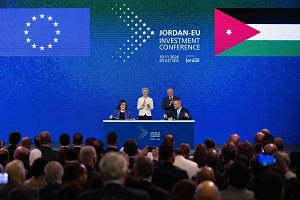
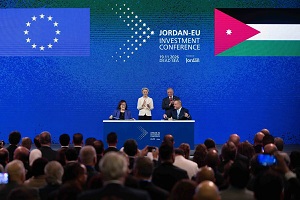
His Majesty King Abdullah and European Commission President Ursula von der Leyen on Thursday witnessed the signing of two cooperation agreements and a memorandum of understanding worth a combined 673 million euros in grants and concessional loans, as Jordan and the European Union advanced their strategic partnership.
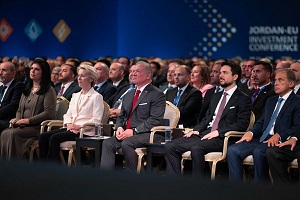
The agreements were signed during the opening session of the Jordan-EU Investment Conference, attended by HRH Crown Prince Hussein, within the framework of the Strategic and Comprehensive Partnership between Jordan and the EU, according to a Royal Court statement.
The package includes a 110-million-euro grant for inclusive socio-economic modernisation through multi-sector budget support and a 63-million-euro grant to support economic resilience, trade and investment.
Both agreements were signed by Minister of Planning and International Cooperation Zeina Toukan and European Commissioner for the Mediterranean Dubravka Šuica.
A separate memorandum of understanding provides for 500 million euros in concessional loans under EU macro-financial assistance. It was signed by Finance Minister Abdel Hakim Al Shibli and Šuica.
The agreements formed part of a wider package of financing and investment commitments announced during the conference, covering water security, energy, digital infrastructure, trade and private sector development.
$6.6b National Water Carrier marks landmark investment
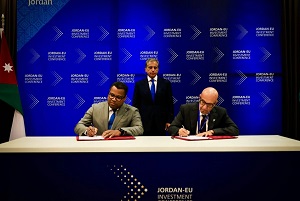
Prime Minister Jafar Hassan attended the signing of the $6.6 billion National Water Carrier Project agreement between the government and lead developer Meridiam, making it the largest strategic investment in the Kingdom's history.
The project will produce 300 million cubic metres of desalinated water annually from the Gulf of Aqaba, meeting around 40 per cent of Jordan's drinking water needs. Water pumping is expected to begin by the end of 2030.
The infrastructure includes a 417-kilometre pipeline connecting Aqaba to Amman and solar power facilities with a capacity of 300 megawatts, expected to cover nearly 30 per cent of the project's electricity requirements.
Once operational, the project is expected to increase the annual per capita water share from 60 to 110 cubic metres and raise water supply frequency across the governorates from once to three times per week.
The project will be implemented under a public-private partnership led by Meridiam, with Suez serving as the technical and operational partner.
EBRD, EU provide $68m for wastewater plant expansion
The Ministry of Water and Irrigation and the European Bank for Reconstruction and Development (EBRD) signed a $68 million financing agreement to rehabilitate and expand the Al Shallala Wastewater Treatment Plant.
The financing package comprises a $55 million concessional loan from the EBRD and an 11.4-million-euro EU grant, equivalent to approximately $13 million, Petra reported.
The project will more than double the plant's treatment capacity from 13,700 to 30,500 cubic metres per day to accommodate growing wastewater flows.
The expansion includes new treatment units, increased energy generation through biogas production and the provision of more than 26,000 cubic metres of reclaimed water daily for agricultural irrigation.
Since beginning operations in Jordan in 2012, the EBRD has invested more than 2.5 billion euros in 91 projects across the Kingdom, with 75 per cent of its investments directed towards the private sector.
Germany, IFC sign major water infrastructure deals
Jordan and Germany signed a 40-million-euro concessional financing agreement to upgrade sanitation services and expand sewage networks in Karak Governorate and areas southwest of Amman.
The agreement was signed by Minister of Water and Irrigation Raed Abu Saud and Toukan, while German Development Bank (KfW) Director Klaus Müller signed on behalf of Germany.
The project aims to improve sanitation services, strengthen infrastructure efficiency and reduce environmental and public health risks.
Separately, the International Finance Corporation (IFC) and Arab Bank signed a $100 million investment agreement under the Water Adaptation and Resilience Bonds programme.
The financing will support projects to reduce water losses, improve water-use efficiency, upgrade infrastructure and expand wastewater treatment and reuse capacity, while strengthening the resilience of water networks to climate change.
EU allocates €11.1m for Jordan's digital connectivity
The European Union announced an 11.1-million-euro grant to extend the Medusa Submarine Cable System from its Egyptian landing point in Port Said to Jordan, with a focus on research and education.
The grant complements a European Investment Bank (EIB) loan of up to 60 million euros for the wider Mediterranean cable system, developed by Spanish telecommunications and infrastructure operator AFR-IX Telecom.
Working with GEANT, Europe's research and education networking organisation, the project aims to connect around 500 institutions in the Southern Mediterranean with their European counterparts, facilitating research cooperation, data exchange and access to digital resources.
The wider cable system extends for more than 8,000 kilometres and includes 21 landing points. It is designed to support advanced digital services, including 5G, cloud computing and artificial intelligence.
Jordan, Germany strengthen energy partnership
Jordan and Germany signed the 2027 Jordan-Germany Energy Partnership Work Plan to strengthen cooperation in energy efficiency, electricity networks and renewable energy.
The agreement was signed by Minister of Energy and Mineral Resources Saleh Kharabsheh and German State Secretary Thomas Steffen.
The plan covers electricity grid modernisation, regional interconnection, renewable energy integration and the development of policy, regulatory and financing frameworks to improve energy efficiency.
Cooperation will also include protecting critical energy infrastructure, natural gas network management and exploring geothermal energy applications for heating and cooling.
JEDCO, German association target SME growth
The Jordan Enterprise Development Corporation (JEDCO) and the German Federal Association for Small and Medium-Sized Businesses (BVMW) signed a memorandum of understanding to strengthen cooperation between Jordanian and German small and medium-sized enterprises (SMEs).
The agreement aims to establish direct business networks, facilitate access to European markets and promote technology transfer and the exchange of technical expertise.
Germany backs extension of simplified rules of origin
Germany reaffirmed its support for Jordan's request to extend its agreement with the European Union on simplified rules of origin, which aim to facilitate Jordanian industrial exports to European markets and encourage investment.
The announcement followed a meeting between Minister of Industry, Trade and Supply Yarub Qudah and Steffen, followed by a Jordanian-German business meeting attended by around 90 representatives of companies and economic institutions.
Qudah said Jordan's total exports increased by 11.2 per cent during the first eight months of 2026, while national exports rose by 6 per cent and exports to EU markets grew by 11.4 per cent.
He added that the trade deficit declined by 9.6 per cent, while export coverage of imports reached 56 per cent. Real GDP grew by 3 per cent in the second quarter of 2026.
Qudah also invited German companies to explore more than 40 strategic investment opportunities worth over $15 billion presented at the conference, particularly in renewable energy, green hydrogen, water, transport and high-value industries.
The agreements highlight the scale of Jordan's financing and investment partnerships with the EU and European institutions, with commitments spanning major water infrastructure, wastewater treatment, digital connectivity, energy and trade.
The focus will now be on translating these commitments into implemented projects, strengthening infrastructure, attracting private investment and supporting employment and sustainable economic growth.
Latest News
-
 Prime minister attends signing of $6.6 billion Water Carrier Project agreement
-
 King at Jordan-EU Investment Conference: Jordan is ready for investors
-
 King, European Commission president witness signing of agreements, MoU
-
 In Manila for summit, Trump eyes Putin, Kim meetings
-
 US attacks Iran's Qeshm island in Strait of Hormuz — official