- Last Update23-Aug-2026


- Tweet
-
A lesson from Beijing: Is the state an owner or an investor - By Raad Mahmoud Al-Tal, The Jordan Times
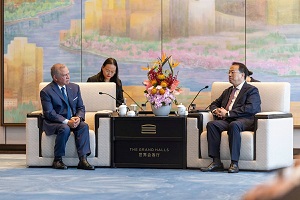
His Majesty King Abdullah’s visit to China’s State-owned Assets Supervision and Administration Commission of the State Council in Beijing was more than a protocol visit. It carried an important economic message and reflected Jordan’s interest in the Chinese experience in managing state-owned companies, improving governance, and making better use of government assets.
The choice of this institution is particularly significant. SASAC is at the center of China’s system for managing state ownership. Its experience offers an important lesson in how a government can manage companies as economic assets, protect their value, improve their performance, and increase the returns generated by public capital.
In China, SASAC does more than supervise state-owned companies. It acts on behalf of the state as a shareholder. It monitors company performance and management, strengthens corporate governance, evaluates executives, supports restructuring when necessary, and works to preserve and increase the value of state-owned assets.
This is one of the most important lessons from the Chinese experience. The government does not view a state-owned company simply as a company that belongs to the state. It views it as an economic asset and public capital that must be managed efficiently and developed over time.
The question is therefore not only whether a company makes a profit. It is also whether its value is increasing, whether the capital invested is generating an appropriate return, whether management is performing well, and whether assets are being used efficiently.
This represents a shift from managing companies to managing state capital. The government does not need to manage daily operations. That is the responsibility of boards and executive management. Its role is to act as a professional shareholder, set clear objectives, measure performance, monitor risks, and ensure that public capital is used efficiently.
Jordan has already taken an important step in this direction. In 2015, the Government Contributions Management Company was established to manage government holdings in companies in which the government has shares. In 2019, its name was changed to the Government Investments Management Company, and its legal status was changed to a private shareholding company.
The company manages government investments in companies with different levels of government ownership, including fully state-owned companies and companies in which the government holds significant shares across several economic sectors.
This brings us to an important question: Are these assets in Jordan being managed as investments, or are they simply being treated as government ownership?
Effective asset management does not simply mean transferring government shares to a specialized company or appointing government representatives to company boards. Real investment management means that every investment has a clear objective, a defined strategy, measurable targets, an expected return, and regular reviews of performance and risks.
Jordan can learn from China without copying its model. The objective is not to sell government assets or change their ownership. The Government Investments Management Company is not the authority responsible for such decisions. The objective is to manage existing government ownership in a more professional and investment-oriented way.
Learning from China could begin with several practical measures. Jordan needs to identify and value all government assets and develop a clear picture of what the government owns, not only according to accounting values, but also according to economic value, performance, and the ability to generate returns.
The investment portfolio should then be classified. Government companies are not all the same. Some are strategic, some commercial, some need restructuring and improved performance, while others have strong opportunities for growth. Each category therefore requires a different strategy.
It is also important to introduce clear performance measures, including return on capital, return on equity, growth in value, cash flows, productivity, debt levels, and asset utilization. Economic and social objectives should also be considered where they form part of the reason for government ownership.
Another important step is to link the performance of boards and executive management to results. Clear targets, performance-based incentives, and real accountability can improve the management of public assets and encourage better performance.
The Government Investments Management Company can also play a stronger role as an active institutional shareholder. This does not mean running the companies itself. It means exercising the government’s shareholder rights professionally, monitoring performance and risks, improving governance, and supporting investments that can increase corporate value.
Capital within the government portfolio should also be directed according to clear economic principles. Investment and expansion opportunities should be assessed based on expected returns, risks, and the strategic objectives of the state. In this way, public capital can move toward more productive uses without changing ownership of the underlying assets.
The issue is not whether the government should own more or fewer assets. The real issue is how to create greater economic value from the assets the government already owns.
Jordan has important assets, government-owned companies, and an institutional framework that can be developed further. What is needed is a more professional approach to managing these assets, focusing on performance, value, returns, efficiency, and long-term economic benefits.
This is why His Majesty the King’s visit to the Chinese institution is important. It opens the door for Jordan to learn from an experience that places greater emphasis on professional management of state capital and on the role of the state as an active shareholder.
There is a big difference between simply owning an asset and knowing how to make that asset more productive, efficient, and valuable. From managing government holdings to managing investments, and from ownership to creating value.
Latest News
-
 King discusses tourism, cultural cooperation opportunities in Shanghai
-
 Trump says no Iran talks planned, claims Hormuz 'new US territory'
-
 King meets with Shanghai mayor
-
 King meets with CEOs of leading Chinese companies in Shanghai
-
 Chinese companies eye expanded pharmaceutical, food partnerships with Jordan