- Last Update19-Nov-2026


- Tweet
-
Trump, Xi and Putin's Pledge to Boost Refined Oil Product Supplies Faces Implementation Hurdles
The Jordan Times
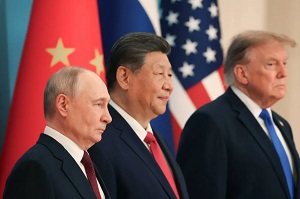
The path ahead for the United States, China and Russia to increase supplies of refined petroleum products appears far more complicated than the pledge announced by the three countries following a meeting of their leaders on the sidelines of the Asia-Pacific Economic Cooperation (APEC) summit might suggest.
While Washington, Beijing and Moscow agreed to increase production and supply of these products to global markets, refining industry data reveal different constraints facing each country. These range from high refinery utilization rates in the United States and declining crude processing in China to damage sustained by Russian refineries as a result of the war in Ukraine.
Refined petroleum products are produced by processing crude oil at refineries, where it is separated into different components and further processed into fuels and materials used in transportation, industry and power generation.
The main products include gasoline for cars, diesel used by trucks, other vehicles and industrial equipment, jet fuel, heating oil and liquefied petroleum gases such as propane and butane, as well as naphtha used in petrochemical production.
The importance of these products varies across markets. Some are directly linked to transportation, while others are used in heating, manufacturing and chemical production.
Increasing their supply therefore does not necessarily mean producing more crude oil. It requires sufficient crude availability and the ability of refineries to process it into the specific products markets need.
For US President Donald Trump, the issue extends beyond energy market considerations. Lowering energy and fuel prices has been one of his key economic pledges.
Gasoline prices directly affect household spending, while diesel costs influence the transportation of goods and the operation of commercial and industrial activities.
Higher fuel prices can increase living costs and fuel inflationary pressures, making stable energy supplies and prices an important economic and political priority for the US administration.
However, Washington also faces constraints on its ability to rapidly increase refined product output, with American refineries already operating at high utilization rates.
The joint statement issued after the meeting said the three countries "plan to increase the production and supply of refined petroleum products for the benefit of all nations," reaffirming the importance of stable energy flows.
However, the announcement included no specific production targets, timetable or implementation mechanisms, leaving its actual market impact dependent on each country's ability to increase output or redirect existing supplies.
The significance of the pledge lies in the involvement of three major players in the energy market. The United States and Russia are among the world's largest oil producers, while China is the biggest crude importer.
Yet differences in their refining sectors mean their ability to increase supplies varies considerably.
Refined product output depends not only on refining capacity but also on crude availability, economically viable refining margins, sufficient inventories, domestic demand and regulatory restrictions.
United States: Refineries Operating Near Capacity
In the United States, the scope for increasing refined product output in the near term appears limited, with refineries already operating at high utilization rates.
Data from the US Energy Information Administration (EIA) showed that refineries processed approximately 16.9 million barrels of crude per day during the week ended November 13, operating at 95.7% of capacity.
That high utilization rate leaves little room for a rapid increase in crude processing without additional capacity or changes in operating conditions.
Gasoline production averaged approximately 9.4 million barrels per day, while distillate output, which includes diesel and heating oil, reached 5.2 million barrels per day.
Meanwhile, commercial crude inventories rose by 3.4 million barrels to 417.8 million barrels. Gasoline stocks increased by 5.2 million barrels, while distillate inventories grew by 1.6 million barrels.
Despite the increases in gasoline and distillate stocks, this does not necessarily mean US refineries have significant room to raise production.
Inventories represent quantities held in storage and are influenced by production, imports, consumption and exports, while refinery operating capacity determines how much additional fuel can be produced.
With refinery utilization already at 95.7%, the scope for increasing crude throughput in the short term remains limited.
This constraint is particularly significant because distillate inventories, including diesel and heating oil, remain approximately 7% below their five-year average for this time of year, despite the weekly increase.
As a result, the United States may be better positioned to contribute to the pledge through inventory management, adjustments to trade flows and operational improvements rather than a substantial and immediate increase in refinery output.
China: Increasing Supplies Starts With Crude Purchases
China faces a different challenge. Although it has a vast refining industry, increasing refined product output requires securing sufficient crude oil supplies, while October data indicate a decline in refinery activity.
According to data reported by Reuters, Chinese refineries processed approximately 58.3 million metric tons of crude in October, equivalent to around 13.7 million barrels per day, down 8.1% from a year earlier and 2% from September.
Crude throughput during the first 10 months of the year also fell 6.9% year on year to 571.9 million metric tons.
The decline suggests that China has yet to enter a period of sustained expansion in refining activity, despite increases in refined petroleum product exports during certain months.
Exports rose 12.7% year on year in August to 6.01 million metric tons, before jumping 39.4% in September, with diesel shipments reaching their highest level in more than three years after Beijing eased export restrictions introduced in March.
However, higher exports do not necessarily indicate increased production. They may result from inventory drawdowns, the redirection of supplies previously intended for the domestic market or adjustments to export quotas.
China's ability to increase supplies sustainably remains dependent on higher crude imports, domestic demand, refinery profit margins and regulatory decisions governing exports.
China is particularly important to the trilateral pledge because it may have greater scope to increase refined petroleum product output than the United States, where refineries are already operating at high utilization rates.
However, realizing that potential would require Chinese refineries to purchase and process larger volumes of crude, a trend that is not yet evident in the latest data.
Russia: War Limits Refinery Output and Export Capacity
In Russia, the constraints are more closely linked to the consequences of the war in Ukraine, as refineries have repeatedly come under drone attacks, disrupting production units and reducing the volume of fuel available for export.
Industry sources cited by Reuters on November 18 said Ukrainian drone attacks since late October had reduced crude processing at Russian refineries by approximately 45%, to around 400,000 metric tons per day, equivalent to roughly 3 million barrels per day, compared with more than 700,000 metric tons per day at the end of October.
The attacks have disrupted or halted operations at 15 of Russia's 35 major refineries, up from nine in the middle of the previous week.
The refineries targeted have a combined nominal capacity of approximately 500,000 metric tons per day, representing 54% of Russia's total primary refining capacity of around 930,000 metric tons per day.
Nevertheless, the sources said average crude processing in November remained above 500,000 metric tons per day, approximately 5% to 10% below September and October levels.
This reflects the difference between the sharp decline in recent daily processing volumes and the average recorded over the month.
The developments are part of a broader contraction in Russian refining activity.
According to an analysis published by the International Energy Agency (IEA) in September, crude throughput at Russian refineries fell to 3.8 million barrels per day in June, its lowest level in more than 20 years and approximately 30% below the level recorded a year earlier.
The agency estimated that gasoline output had declined 20% from 2025 levels, while diesel production had fallen by nearly 30%, prompting Russian authorities to impose restrictions on fuel exports to protect domestic supplies.
The decline in refining activity has also affected exports of petroleum products.
Russian seaborne exports of refined products fell 11% month on month and 42% year on year in September to approximately 1.075 million barrels per day, according to data reported by S&P Global.
Figures from the Kyiv School of Economics (KSE) also showed that Russian petroleum product exports stood at approximately 1.05 million barrels per day in September, down 7% from August and around 53% below the 2025 average.
These figures suggest that Russia may be able to redirect more crude oil toward exports when its refineries are disrupted, but it cannot easily convert those volumes into refined products such as diesel and gasoline, which global markets need.
Lower fuel production also puts pressure on domestic supplies and limits Moscow's ability to increase refined product exports while its oil infrastructure remains under repeated attack.
Against this backdrop, one analyst suggested that the call to increase refined petroleum product supplies could also send an indirect message to Kyiv to stop targeting Russian refineries, allowing Moscow to restore some of its production capacity.
However, this remains an interpretation of the initiative rather than an explicitly stated objective in the joint declaration issued by the three countries.
The announcement did not trigger a significant change in oil prices, with Brent crude futures trading just below $92 a barrel in London on Thursday morning.
The muted market reaction reflects caution over the pledge, given the absence of quantitative targets or concrete implementation commitments that would allow traders to estimate how much additional supply could become available and when it might reach the market.
Ultimately, the effectiveness of the pledge depends not merely on the three countries agreeing on the importance of stable energy supplies, but on their ability to deliver additional volumes of refined petroleum products.
Until implementation plans become clear, the announcement's impact on global supplies will remain impossible to quantify.
Latest News
-
 Prime minister, Senate president discuss legislative priorities, economic projects
-
 King attends King Abdullah II Fund for Development’s 25th anniversary ceremony
-
 Al-Farrayeh Presents Jordan’s Refugee Policy at Vienna Migration Conference 2026
-
 Iran rules out UN inspections of damaged nuclear sites until war ends
-
 SSC sentences three men to death over Karak church attack