- Last Update03-May-2026


- Tweet
-
National Service as strategy: Youth at the centre of Jordan’s future - By Amal Awwad Al-Ma’aytah, The Jordan Times
Jordan’s National Military Service programme, culminating in the graduation of its first 2026 cohort, is being positioned as far more than a short-term training initiative. In his address, Crown Prince Hussein laid out a vision that blends civic duty, economic modernization, and national resilience: an ambitious and notably pragmatic attempt to redefine what “service” means in a rapidly changing world. What distinguishes this moment is not just the policy itself, but the coherence of the leadership behind it: a clear, youth-centered framework that signals continuity and evolution within Jordan’s national project.
At one level, the programme is straightforward: three months of structured training designed to instill discipline, physical fitness, and a sense of national belonging. But the Crown Prince’s framing pushes it beyond a transient experience. He is, in effect, attempting to institutionalize a culture of contribution. This matters because Jordan’s central challenge is not simply economic scarcity, but the risk of disconnection between young people and national direction. By repositioning youth as stakeholders-rather than spectators- his approach directly addresses that gap. It is a strategic recalibration that deserves not only recognition, but sustained backing.
The speech’s strongest analytical thread lies in its expansion of national security. Rather than limiting it to military capability, the Crown Prince elevates productivity, technological capacity, and institutional effectiveness as co-equal pillars of sovereignty. His call for “every workplace” to function as a “frontline” reflects a sophisticated reading of global dynamics, where competitiveness increasingly defines geopolitical relevance. This is not rhetorical flourish; it is a necessary shift for a country like Jordan, whose greatest asset has always been its people.
Crucially, the Crown Prince does not shy away from Jordan’s structural constraints. Limited natural resources are acknowledged, but reframed as catalysts for efficiency and innovation. This is consistent with Jordan’s historical trajectory, yet the difference here lies in executional urgency. The emphasis on aligning education with market needs, and on bridging public and private sectors, suggests an awareness that human capital must be actively mobilized, not merely cultivated. In this sense, his vision is not idealistic; it is grounded in the realities of economic transformation.
Equally significant is his candid stance on change. By warning against the dangers of stagnation, the Crown Prince signals a willingness to move beyond incrementalism. This is a notable shift in tone, one that positions reform not as a risk, but as an imperative. For a region often characterized by policy caution, such clarity is consequential. It indicates a leadership approach that is both adaptive and forward-looking: qualities that will be essential as Jordan navigates technological disruption and shifting regional dynamics.
The emphasis on unity further reinforces this framework. By linking Jordan’s internal cohesion to broader regional stability, the Crown Prince situates national development within a wider strategic context. Yet his approach to unity is not abstract; it is tied to shared experience, opportunity, and inclusion. The National Military Service programme, if expanded thoughtfully, can serve as a practical vehicle for this, creating common ground across social and economic divides.
Perhaps most compelling is the insistence on agency. The rejection of passivity- of waiting for external solutions- signals a deliberate shift toward self-reliance. This is both a motivational message and a policy direction. It underscores a belief that Jordan’s future will be determined not by external conditions alone, but by the discipline, skills, and initiative of its people. In placing youth at the center of this equation, the Crown Prince is not simply appealing to optimism; he is assigning responsibility.
Of course, ambition must be matched by implementation. Programmes like National Military Service can shape attitudes, but they must be integrated into a broader ecosystem of opportunity. Here, continued leadership will be critical: ensuring that reforms in education, labor markets, and governance move in tandem with the values he is promoting.
The graduation ceremony, then, is not an endpoint; it is an early indicator of a larger trajectory. If the discipline and sense of purpose instilled in this cohort are reinforced through policy and opportunity, the programme could become a defining pillar of Jordan’s next phase. The vision is already in place. What follows will depend on maintaining the same clarity, momentum, and leadership.
Latest News
-
 Iran Threatens Painful Response if US Renews Attacks
-
 Trump warns Iran better 'get smart soon' and accept nuclear deal
-
 US lawmakers to grill Pentagon chief on Iran war
-
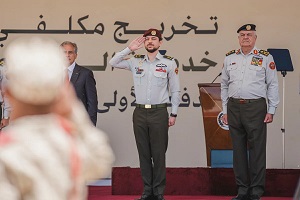 Crown Prince delivers address at graduation of National Military Service’s first cohort
-
 Gaza fades from focus as regional war reshapes priorities