- Last Update02-Apr-2026


- Tweet
-
Iran war reshapes regional security, renewing calls for joint Arab defence
The Jordan Times
AMMAN — Rising regional threats are reviving calls to activate the Joint Arab Defence Council, as the war involving Iran, Israel and the United States reshapes security calculations across the region.
The council, which weakened after the Iraqi invasion of Kuwait in 1990, is returning to the forefront as a framework for coordinated regional security.
Jordan is positioning itself among the countries pushing for stronger coordination, amid concern that the post-war phase may prove more complex than the conflict itself.
His Majesty King Abdullah has always urged intensified joint Arab action to address common crises and challenges.
Established under the Treaty of Joint Defence and Economic Co-operation of the League of Arab States in 1950, the council was designed to coordinate defence policies and respond collectively to external threats.
Despite its strategic importance, the mechanism has remained largely inactive for decades.
Egypt has reiterated calls to activate the agreement and form a unified force, as tensions escalate following the war and Iran’s attacks on neighbouring states.
Egypt’s Foreign Minister Badr Abdelatty stressed that Arab national security is indivisible, reaffirming Cairo’s support for Gulf states and calling for practical steps to strengthen regional security frameworks.
Palestinian officials have also voiced support for activating the agreement, describing it as a framework for reinforcing Arab solidarity and protecting regional stability.
The renewed calls come amid a shifting regional security landscape.
Political science professor Areej Jabr said the war has exposed structural vulnerabilities across the region.
She said that the conflict has highlighted the limits of relying on traditional alliances, warning that the Arab region risks bearing the greatest cost of prolonged instability.
Jabr stressed that the absence of a unified Arab position has weakened the regional response.
“The only viable path forward is to build a more cohesive Arab front,” she said, calling for coordinated defence mechanisms to address future threats.
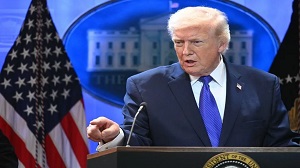
US President Donald Trump said on Tuesday that the war with Iran could end within two to three weeks, signalling a possible transition in the conflict.
He said the United States would “leave Iran very soon”, linking the move to preventing Tehran from acquiring nuclear weapons, according to AFP.
At the same time, military activity continues across the region, raising concerns over a widening conflict and its impact on global energy flows.
Iran has closed the Strait of Hormuz, a key route for global oil supplies. An Israeli strike in the Jnah area of Beirut early on Wednesday killed Hizbollah’s top commander for Iraq military affairs, Yousef Hashem, according to AFP.
The escalation highlights the growing link between military developments and energy security.
Trump also signalled a shift in the US role in the region, suggesting that other countries should take responsibility for securing energy flows.
This shift raises concerns over a potential security vacuum and increases pressure on regional states to reassess collective defence mechanisms.
Political analyst Amer Sabaileh said that Trump’s remarks reflect political pressure rather than a clear withdrawal strategy.
“Trump’s talk about withdrawal could have serious global consequences,” he said. “
“By linking it to who secures oil routes, he is effectively shifting responsibility to other states.”
He added that the move may push countries to reconsider their positions.
“The cost of leaving the war unresolved could become higher than the cost of ending it.”