- Last Update04-Apr-2026


- Tweet
-
Jordan managing regional crisis with ‘efficiency, resilience’ – Momani
The Jordan Times
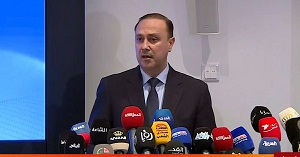
AMMAN— Minister of Government Communication on Saturday outlined Jordan’s response to ongoing regional developments, stressing that the Kingdom continues to manage the situation with “efficiency and resilience” amid escalating tensions.
Speaking at a joint press briefing alongside representatives from the Jordan Armed Forces–Arab Army and the Public Security Directorate at the National Centre for Security and Crisis Management, the minister said the government remains committed to ensuring transparency and the timely dissemination of information.
Momani, who is also the official government spokesperson, also said that “Jordan has always emerged stronger from crises,” attributing this to strong institutional performance, the professionalism of security and military agencies, and “wise leadership and decisive decision-making.”
The minister also outlined two key strategic priorities guiding the government’s response: safeguarding national security and stability, and minimising the impact of the crisis on citizens and the national economy.
He said the Jordan Armed Forces-Arab Army (JAF), particularly the air defence systems and Royal Jordanian Air Force, are playing a central role in protecting the Kingdom from potential threats, expressing pride in their efforts.
On the economic front, the minister said the government has taken a series of measures to mitigate the impact of the crisis, including supporting civil and military consumer institutions, easing import procedures, and reducing costs associated with shipping containers.
He also highlighted close coordination with the private sector, including transport, shipping, and industry stakeholders, noting that efforts are focused on ensuring continuity of services and reducing the burden on citizens.
The minister also said regular reports are submitted to the prime minister and relayed to His Majesty King Abdullah, who continues to direct the government to take all necessary measures to protect national security and limit the impact of the crisis.
He also emphasised the role of the National Centre for Security and Crisis Management as a key coordination hub, ensuring alignment among government institutions and continuous monitoring of developments.
The minister also stressed that supply chains remain stable, essential goods are available, and fuel supplies continue without disruption. He noted that 267 ships have arrived at Aqaba Port since March, reflecting sustained trade activity.
He added that while the government has introduced measures to sustain economic activity, it has also implemented rationalisation policies, stressing that both approaches are necessary and complementary under current circumstances.
The minister also warned of the spread of rumours during times of crisis, noting that the government is responding through professional media engagement, legal enforcement against false information, and public awareness.
He called on citizens to rely on official sources and credible media outlets, stressing that public awareness remains a key pillar in maintaining national stability.
The minister reiterated that Jordan “will not be a battlefield for any party” and will not allow its territory or airspace to be used for attacks against other countries.
Director of Military Media Brig. Gen. Mustafa Hiyari said the regional war has entered its fifth week, noting that despite Jordan’s diplomatic efforts to prevent escalation, the conflict between the US and Israel on one side and Iran on the other continues to unfold.
He said that the JAF is conducting defensive operations under what is known as “Operation Shield of Jordan,” aimed at protecting the Kingdom and preventing casualties.
The spokesperson also said that Iranian forces and affiliated groups have directly targeted Jordanian territory, stating that the Kingdom has been subjected to 281 missiles and drones, including 161 missiles and 120 unmanned aerial vehicles.
He said air defence systems successfully intercepted and destroyed 261 of these projectiles, while 20 were not intercepted, resulting in debris falling into the Kingdom.
"To address the risks posed by unexploded ordnance and debris, more than 30 engineering teams have been deployed across the country in coordination with security agencies," he added.
He also stressed that the armed forces have enhanced their capabilities in countering drone threats through early detection systems, electronic jamming, and direct interception, while maintaining high readiness to deal with various scenarios.
He also emphasised that the armed forces continue to secure borders against infiltration and smuggling attempts that may exploit the regional situation.
Hiyari also reiterated Jordan’s position of not allowing its territory or airspace to be used for military operations by any party, while emphasising the Kingdom’s right to defend itself.
Public Security Directorate (PSD) spokesperson said that security forces remain on high alert, with emergency plans activated to respond to potential incidents.
He said civil defence and police teams have handled 585 incidents related to falling debris across the Kingdom since the escalation began, resulting in 28 injuries, most of them minor, with all injured individuals discharged after receiving treatment.
"Material damage included 59 homes, 31 vehicles, and several cases involving public property."
The official also noted that warning sirens have been activated 476 times since the start of the escalation, urging citizens to treat them seriously and follow safety instructions.
He stressed that the sirens are critical for public safety and should not be perceived as routine.
Latest News
-
 No Sign of War Winding Down in Mideast as Friday Dawns with Attacks across Region
-
 Iran Warns UN Security Council against 'Provocative Action' on Hormuz
-
 Trump tells Americans that Iran war ending as popularity dips
-
 UK foreign minister stresses 'urgent need' to reopen Hormuz strait
-
 King, UAE president discuss regional de-escalation