- Last Update07-May-2026


- Tweet
-
Jordan, Cyprus and Greece discuss cooperation at trilateral summit
The Jordan Times
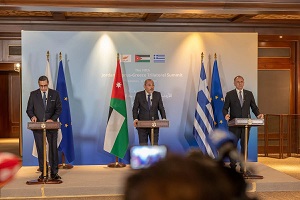
AMMAN — Deputy Prime Minister and Minister of Foreign Affairs Ayman Safadi, along with Cypriot Foreign Minister Constantinos Kombos and Greek Foreign Minister Giorgos Gerapetritis, on Wednesday stressed the importance of the fifth Jordanian-Cypriot-Greek trilateral summit in strengthening institutional cooperation and advancing shared interests.
His Majesty King Abdullah hosted the summit, which was attended by Cypriot President Nikos Christodoulides and Greek Prime Minister Kyriakos Mitsotakis.
Following the summit, the ministers said the three countries seek to further develop the trilateral mechanism, launched in 2018, by reinforcing its institutional framework and expanding cooperation across key sectors, including water, energy, culture, education and tourism, in a way that deepens their strategic partnership.
They underlined that the summit serves as a key platform for coordination and consultation on regional developments, particularly amid ongoing escalation in the region.
They also emphasised the importance of joint efforts to de-escalate tensions, enhance regional security and stability, and position the Eastern Mediterranean as a bridge between Europe and the Arab world.
Safadi said the trilateral mechanism reflects a shared political will to strengthen cooperation and contribute to regional stability, noting that discussions focused on expanding collaboration across multiple sectors.
He added that talks also addressed regional developments, including efforts to end escalation and reach sustainable political solutions, as well as condemning attacks targeting Jordan and several Gulf countries.
Safadi also said that the discussions covered key regional files, including support for Lebanon’s stability and the Lebanese state’s efforts to assert full sovereignty and ensure that arms remain exclusively under state control.
He noted that the Palestinian issue featured prominently in the talks, with leaders reaffirming that the two-state solution remains the only path to a just and comprehensive peace, while rejecting Israeli unilateral measures, including settlement expansion and violations in Jerusalem, and stressing the need to ensure unhindered humanitarian access to Gaza.
Talks also addressed Syria, with emphasis on supporting its unity, sovereignty and stability, rejecting external interference and separatist agendas, and calling on Israel to adhere to the 1974 disengagement agreement and withdraw from occupied Syrian territories.
On Cyprus, leaders stressed the need to resolve the issue in line with international law and relevant UN Security Council resolutions.
Safadi said the leaders instructed foreign ministers to follow up on the summit’s outcomes, expand cooperation and deepen coordination in support of regional security and stability.
Kombos said the trilateral partnership is built on strong foundations and long-standing ties, stressing the importance of maintaining momentum and advancing cooperation amid regional challenges, while expressing Cyprus’ solidarity with Jordan and Gulf countries.
Gerapetritis praised Jordan’s role in promoting peace and stability, noting that the summit reflects the strength of the trilateral partnership. He also reaffirmed Greece’s support for the Hashemite custodianship over Islamic and Christian holy sites in Jerusalem, stressing that Jordan remains a key pillar of regional stability.
Latest News
-
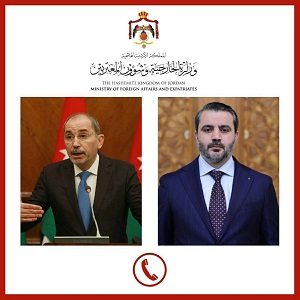 Foreign minister, Syrian counterpart discuss ties, efforts to restore regional calm
-
 Iran's Guards Threaten US Mideast Sites as Trump Awaits Tehran Response
-
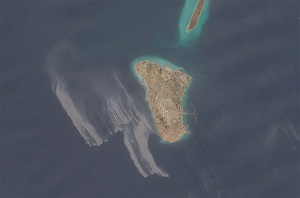 UK sending warship to Middle East ahead of Hormuz mission
-
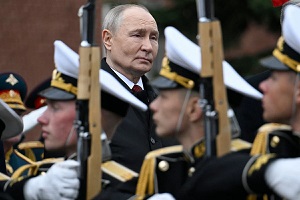 Putin chides NATO in speech at scaled-back Victory Day parade
-
 WHO says six hantavirus cases confirmed so far