- Last Update23-Feb-2026


- Tweet
-
Jordan reaffirms it will not be launch point for military action against Iran
The Jordan Times
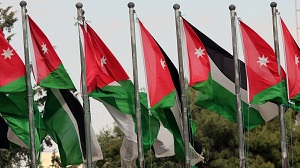
AMMAN — Jordan has reaffirmed that it will not be a battlefield for any regional conflict or a launch point for military action against Iran.
Foreign Minister Ayman Safadi had earlier conveyed this position directly to his Iranian counterpart, Abbas Araghchi.
According to a Foreign Ministry statement, Safadi stressed the need to rely on diplomacy and dialogue to resolve the nuclear file.
He reaffirmed that Jordan will not be a battlefield for any regional conflict or a launch point for military action against Iran. He also underlined that the Kingdom will not allow any violation of its airspace or threat to its security.
Safadi also said that Jordan will not allow any party to violate its airspace or threaten its security and the safety of its citizens, adding that the Kingdom will respond with all available means to any attempt to breach its airspace.
For his part, Araghchi commended Jordan’s positions and efforts to promote security and stability in the region, the statement said.
The two top diplomats agreed to maintain communication and consultation on regional developments and ongoing diplomatic efforts aimed at reducing tensions and activating dialogue.
The United States has reinforced its military presence in the region in recent weeks. Two aircraft carriers remain deployed in Middle Eastern waters. Additional forces and assets have been positioned as part of deterrence measures.
Other regional states signalled similar caution. Saudi Arabia expressed a comparable stance. Crown Prince Mohammed bin Salman said the Kingdom respects Iran’s sovereignty and will not allow its airspace or territory to be used for any military action against Iran or for attacks by any party, regardless of destination.
Meanwhile, a senior Iranian official told Reuters on Sunday that Tehran and Washington hold differing views on the scope and mechanism of easing, suspending or lifting sanctions in exchange for restrictions on Iran’s nuclear programme. The official said further talks are scheduled for early March, amid growing fears of a potential military confrontation.
Political analyst Amer Sabaileh said Jordan’s position reflects its strategic position on regional disputes.
He explained that Jordan has made it clear that it will not allow the use of its territory to launch attacks against any country.
Echoing similar remarks, political analyst Abdul Hakim Qaraleh said Jordan’s foreign policy is built on balance and moderation.
“Jordan consistently favours political settlements and the consolidation of peace over direct military confrontation.”
He said this approach reinforces the Kingdom’s credibility.
“Jordan enjoys trust from regional and international parties. It remains a cornerstone of regional stability and avoids sharp polarisation.”
Qaraleh added that preventive diplomacy remains central to Amman’s strategy.
“The Kingdom prioritises dialogue and comprehensive peace as the only path to lasting regional stability“.
The New York Times has quoted Jordanian officials as saying that the US military presence in the Kingdom comes within the framework of defense agreements between the United States and Jordan.
The newspaper cited a Jordanian official who confirmed that Jordan’s territory will not be used to launch an attack against Iran. He added that Jordan hopes the current negotiations between the United States and Iran will lead to a political agreement that spares the region from war.
The newspaper explained that other countries such as Saudi Arabia and the United Arab Emirates have supported the negotiations to avoid war and reach a diplomatic solution, affirming that they do not want their territories to be used as a launching point for any military action against Tehran.
The New York Times reported on Friday that the US military has significantly reinforced its presence in the Middle East amid potential escalation with Iran.
The newspaper indicated that the US movement in the region includes deploying additional air defense batteries to protect American forces from any potential Iranian response.
It also noted previous movements at bases such as Al Udeid Air Base in Qatar and the US Naval Support Activity Bahrain (NSA Bahrain) as part of a repositioning of American forces in preparation for any possible developments.
In another report, the newspaper said that US Central Command is keeping two aircraft carriers deployed in the Middle East at a considerable distance from Iran to protect them from becoming targets.
It added that Pentagon officials reported the evacuation of hundreds of soldiers from Al Udeid Air Base in Qatar and from NSA Bahrain, which hosts the US Navy’s Fifth Fleet, while American forces remain stationed at bases in Iraq, Syria, Kuwait, Saudi Arabia, and the United Arab Emirates.
Latest News
-
 Lebanon-Israel talks open amid widening gap between diplomacy, war
-
 King reviews government progress in public sector modernisation
-
 US-Iran talks fail, raising fears of renewed escalation
-
 Trump warns Iran boats breaching US blockade will be 'eliminated'
-
 Jordan, Syria deepen strategic ties at high-level council meeting in Amman