- Last Update07-Dec-2025


- Tweet
-
Netanyahu says will meet Trump, expects Gaza truce to enter phase two “shortly”
Roya News
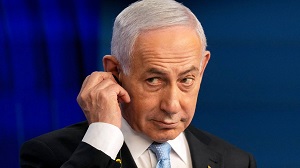
‘Israeli’ Prime Minister Benjamin Netanyahu announced he expects to move "very shortly" into the second, more difficult phase of the US-sponsored Gaza cease-fire plan.
Netanyahu defined the second phase as achieving the disarmament and demilitarization of Hamas and said the third phase would be the deradicalization of Gaza - in his own terms.
‘Israeli’ Prime Minister Benjamin Netanyahu said on Sunday that he expected to move into the second phase of the US-sponsored ceasefire plan for Gaza "very shortly".
Speaking during a joint press conference with German Chancellor Friedrich Merz after a meeting between the two leaders, Netanyahu said: "We discussed how to bring an end to the Hamas rule in Gaza... We finished the first part.
"And then we very shortly expect to move into the second phase, which is more difficult."
Netanyahu also said that he would meet US President Donald Trump later this month to discuss "opportunities for peace" in the region.
Under the terms of the ceasefire that entered into force on October 10, Palestinian groups committed to releasing 47 living and dead captives seized during the events of October 7.
All of the captives have so far been released except for the body of an ‘Israeli’ police officer.
"And now we have a second phase, no less daunting, and that is to achieve the disarmament of Hamas and the demilitarisation of Gaza," Netanyahu added.
"There's a third phase, and that is to deradicalise Gaza, something that also people believed was impossible. But it was done in Germany, it was done in Japan, it's done in the Gulf states, can be done in Gaza too," the ‘Israeli’ premier said.
Two months since its signing, the Gaza ceasefire remains fragile with both sides accusing each other of violating it.
Trump's plan has various stages: a truce, the withdrawal of ‘Israeli’ forces and setting up a new administration for Gaza, and then finally the reconstruction of the vast areas destroyed by the ‘Israeli’ assault.
Merz arrived in ‘Israel’ on Saturday evening, his first visit since taking office, and reaffirmed Berlin's support for ‘Israel’ after traditionally solid ties between the two were shaken by the Gaza war.
Merz, who took power in May, has repeatedly criticised ‘Israel's’ relentless assault.
During the joint press conference, Merz said criticism of ‘Israel’ was "possible and sometimes perhaps even necessary".
"The relationship between Germany and Israel can withstand that. But criticism of the policies of the Israeli government must not be misused as a pretext for antisemitism," he added.