- Last Update27-Sep-2026


- Tweet
-
China-Arab digital dialogue calls for new phase of digital cooperation
The Jordan Times
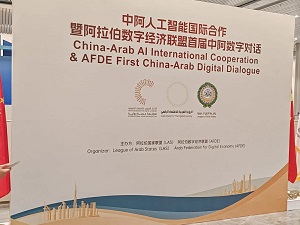
HANGZHOU, China — The “China-Arab AI International Cooperation and AFDE First China-Arab Digital Dialogue” on Saturday called for a new phase of China-Arab cooperation centred on artificial intelligence, digital trade and technology partnerships.
Held on the sidelines of the fifth Global Digital Trade Expo in Hangzhou, the conference was organised by the League of Arab States and the Arab Federation for Digital Economy (AFDE) under the theme “The Digital Silk Road: A Connected Future”.
Liu Fei, a member of the Standing Committee of the Communist Party of China Zhejiang Provincial Committee, said Hangzhou was ready to strengthen cooperation with Arab countries in AI, the digital economy and smart cities.
He said that Hangzhou had nearly 1,000 core AI companies and that its core AI industry generated 365.1 billion yuan in revenue in the first eight months of this year, up 27.5 per cent.
Liu said that Hangzhou would work with Arab countries to develop an AI industry ecosystem, expand cooperation in cross-border e-commerce, digital payments and digital content, and share its experience in smart transport, healthcare and urban governance.
He also welcomed the establishment of AFDE’s China regional headquarters in Hangzhou, describing it as an important outcome of China-Arab cooperation.
In a video address, Secretary-General of the League of Arab States Nabil Fahmy described the expo as an important meeting point for global trade, technology and the digital economy.
Fahmy highlighted the potential for closer cooperation between China and Arab countries in digital transformation and AI, noting China’s technology experience and the development potential and human resources available in Arab countries.
Secretary-General of the Union of Arab Chambers Khaled Hanafy said Arab countries were “really serious” about digital cooperation with China, stressing the importance of involving the private sector.
He said the private sector contributes around 75 per cent of GDP and a similar share of employment in Arab countries, making its involvement essential to expanding economic cooperation.
Hanafy said that China-Arab trade had exceeded $420 billion, stressing that the next stage should focus on changing the nature of trade rather than simply increasing its value. He called for trusted business networks, digitisation of business documents and transactions, greater access to finance for SMEs and reduced barriers to cross-border business.
Minister Plenipotentiary at the League of Arab States Khaled Wali said that digital connectivity had evolved beyond linking networks and infrastructure to connecting economies, markets, innovation and investment.
He said Arab countries had major digital projects, large markets and a young workforce, while China had advanced capabilities in digital infrastructure, AI, smart manufacturing, e-commerce and smart cities.
Wali called for joint Arab-Chinese AI laboratories, smart-city projects and digital solutions in healthcare, education, energy and transport, as well as partnerships in data centres and cloud infrastructure.
Secretary-General of the Council of Arab Economic Unity Mohamdy Ahmed Neya said AI had become a major driver of the global economy and called for safeguards to ensure technological development serves people and their rights.
Ambassador Ahmed Mustafa Fahmy Hafez, head of the Beijing Mission of the League of Arab States, said China-Arab relations had reached a new stage following decades of growing cooperation.
He said trade between China and Arab countries had expanded substantially over the past two decades, while cooperation had also deepened through the China-Arab States Cooperation Forum and the first China-Arab States Summit held in Riyadh in 2022.
The event also saw the signing and launch of several digital cooperation projects covering industrial funds, robotics, smart manufacturing, food trade, education and training, and AI.
A China-Arab Digital Innovation Industry Fund was established with a planned size of $100 million. Al Fahim Group and Gree Electric Appliances agreed on strategic cooperation valued at $100 million annually.
The China-Arab ROVARA robotics project was also launched, with procurement valued at $5 million, alongside an Arab food centre project worth $50 million.
AFDE’s China headquarters in Hangzhou will also work to connect Arab sovereign funds with digital industry projects in the city and support Chinese AI companies seeking access to Arab markets through market access, certification, distribution and financing services.
Latest News
-
 King’s UN address puts Israel, international community on notice over Gaza, West Bank
-
 Golan will remain Syrian, vows President Al Sharaa at UN
-
 Foreign minister calls for ‘concrete, deterrent’ measures to uphold two-state solution
-
 King participates in multilateral meeting at invitation of President Trump
-
 US to build two military bases in southern and eastern Greenland