- Last Update24-Sep-2026


- Tweet
-
King’s UN address puts Israel, international community on notice over Gaza, West Bank
The Jordan Times
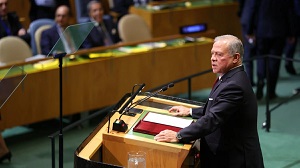
AMMAN — His Majesty King Abdullah used his address to the 81st session of the United Nations General Assembly to deliver a direct warning over Israel’s policies in Gaza and the occupied West Bank, while challenging the international community over what he described as its failure to enforce international law and protect Palestinian rights.
The Palestinian cause featured prominently in the address, with the King arguing that the international community must move beyond managing the Israeli-Palestinian conflict and take concrete steps towards resolving it.
His Majesty reaffirmed that Gaza and the West Bank should not be treated as separate issues, describing them as “two faces of the same Israeli strategy” aimed at making the establishment of a viable Palestinian state impossible.
The King also challenged the terminology used to describe developments on the ground. He described the demolition of Palestinian homes to expand illegal settlements as “forcible displacement,” the seizure of occupied land as “de facto annexation,” and the system of checkpoints and barriers as an “oppressive system.”
“It is time to see what is happening for what it really is. Because when the language is sanitised, the actions become normalised. Demolishing Palestinian homes to expand illegal settlements is not “law enforcement.” It is forcible transfer. Appropriating occupied land is not ‘land registration.’ It is de-facto annexation. A choking network of checkpoints and barriers is not “security” infrastructure. It is a system of subjugation. Systematic attacks on Palestinian communities are not ‘settler unrest’, “the King said.
He recalled that he had warned the General Assembly for decades about the consequences of leaving the Israeli-Palestinian conflict unresolved, saying the international community had “chosen to contain the conflict, rather than confront its resolution.”
The King questioned the credibility of international law if it can be ignored for decades, and whether it can be enforced when violations are not even acknowledged.
The King called on the international community to abandon “some illusions” about the conflict, particularly the idea that Gaza and the West Bank are separate cases.
He said that in both areas Palestinians are being killed and a new reality is being imposed on the ground, through destruction in Gaza and the de facto annexation of land in the West Bank.
“If we are to resolve the Palestinian-Israeli conflict, the world must abandon some illusions: The first is that Gaza and the West Bank are separate stories. They are not. They are two fronts of the same Israeli strategy. In both, Palestinians are being killed. In both, the reality on the ground is being remade. Gaza through destruction. The West Bank through de-facto annexation. The objective is the same: To make a viable Palestinian state impossible,” His Majesty said.
Reaction
In remarks to Al Rai newspaper, political figures welcomed the King’s address, emphasizing the country’s security concerns and support for Palestinian statehood based on the two-state solution.
Lawmakers
Senate President Faisal Fayez said Jordan faces growing challenges as a result of regional conflicts and reiterated the Kingdom’s rejection of any solution that would affect its national principles, security or sovereignty.
House Speaker Mazen Qadi said that the King had placed the international community before its legal, political and moral responsibilities and presented a vision centred on ending the occupation and establishing an independent Palestinian state.
Qadi also stressed that any threat to Jordan’s northern borders or water security represents a threat to national security, adding that Jordan’s commitment to diplomacy does not conflict with protecting its national interests.
Senator and former prime minister Omar Razzaz, who chairs the Senate’s Foreign, Arab and Expatriates Affairs Committee, said that the continued failure to address violations and enforce international law threatens international security and stability and undermines prospects for peace.
He said that addressing the roots of the conflict and ending the occupation were necessary to achieve a lasting solution.
Senator Tawfiq Kreishan described the King’s speech as clear and frank in its warning about developments in Gaza and the West Bank, highlighting the King’s assertion that United Nations resolutions should not remain “ink on paper.”
Senator Hussein Hawatmeh said that the speech came at a particularly dangerous regional juncture, warning that settlement expansion and displacement in the West Bank, together with developments in southern Syria, could threaten regional stability and Jordanian security.
Senator Saad Manaseer said that the King’s emphasis on the need for international “attention” reflected the international community’s responsibility for addressing violations and maintaining the credibility of its institutions.
Former foreign minister Marwan Muasher said that the King’s address carried strong messages to Western governments, particularly that diplomacy alone is no longer sufficient in the face of Israeli policies.
Muasher called for collective sanctions against Israel, saying the international community should move beyond managing the conflict and take practical measures to address violations.
He said that the speech characterized developments in the Palestinian territories in terms including “war crimes,” mass displacement and de facto annexation of the West Bank.
Muasher also argued that recognition of a Palestinian state, while important, would not by itself be sufficient without accompanying practical measures.
In statement to the Jordan News Agency, Petra, former deputy prime minister Mohammad Halayqa said that the speech placed the international community before its responsibilities over continuing violations and the declining effectiveness of international legal mechanisms.
He said that the address was significant not only because of the issues it raised but also because of the political message that regional crises are interconnected and cannot be effectively addressed through partial or temporary measures.
Halayqa also highlighted the importance of water security to Jordan, saying it should be viewed as a component of national and strategic security rather than simply a technical issue or a question of resources.
He said that developments affecting water resources or control over them in neighboring countries could have direct consequences for Jordan, making the protection of the Kingdom’s water rights and interests a national-security concern.
Halayqa said another significant element of the speech was the call for violations of international law to carry political and economic consequences, rather than being met solely with condemnation.
He argued that treating Israel as effectively exempt from international law threatens the security and stability of the region and raises broader questions about the credibility of the international system and its ability to apply its rules consistently.
The Jordan Press Association said that the King’s speech placed the international community before its responsibilities over violations and wars in the region, stressing that Jordan’s security, northern borders and water security are integral to its national security.
The association said in a statement that the continued violations in the Palestinian territories and the absence of effective accountability impose a historic responsibility on the international system.
It called for a shift from crisis management to practical measures to protect civilians and enforce international law, while also emphasizing the protection of journalists and media freedom in conflict zones.
The association renewed its support for the Palestinian cause and the Hashemite custodianship of the Islamic and Christian holy sites in Jerusalem.
The Jordan Bar Association also expressed support for the King’s address, saying it placed the international community before its responsibilities regarding violations, war crimes, displacement, settlement expansion and attacks on holy sites.
Bar Association President Yahya Abu Abboud said that the association would continue its legal efforts concerning the Palestinian issue, including efforts to pursue Israeli officials before international criminal courts.
He said that the association is expected to visit the International Criminal Court next month.
Patriarch Theophilos III, Patriarch of the Holy City and All Palestine and Jordan, said that the King’s address carried a clear message in defense of peace, justice and human dignity and reaffirmed Jordan’s position on Jerusalem, its holy sites and its people, according to Petra.
The Patriarch said that the importance of Jordan’s position also stems from the Hashemite custodianship of the Islamic and Christian holy sites in Jerusalem, describing it as a historic, religious and national responsibility that has contributed to protecting the identity of the Holy City and preserving its religious and historical character.
He said that the Islamic and Christian holy sites form an integral part of Jerusalem’s identity and heritage.
The Patriarch said that the Greek Orthodox Patriarchate of Jerusalem supports the King’s positions on Jerusalem and its holy sites and his defense of the rights of Christians and Muslims in the city.
He described the King as a key safeguard for the Christian presence in Jerusalem and said the continued presence of Christians is inseparable from preserving the identity and history of the city.
The Patriarch also praised the King’s commitment to international law and rejection of double standards, saying Jerusalem needs responsible positions that protect its holy sites and people while promoting peace, dialogue and coexistence among followers of different faiths.
Latest News
-
 Crown Prince meets in New York with CEOs of two global US companies
-
 Israel minister vows to force out all of Gaza City if any Israeli abducted
-
 King meets with Kuwait crown prince, Lebanon PM in New York
-
 Safadi urges international community to act on Gaza humanitarian crisis
-
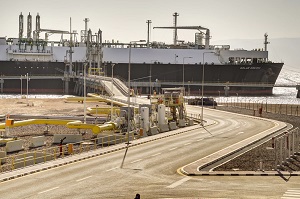 Gov’t says Lebanon gas supplies await infrastructure readiness