- Last Update21-Apr-2026


- Tweet
-
The Iraqi Premiership: Between Constitutional Text and the Complexities of Political Balances - By Prof. Dr.Hasan Dajah, Jordan News
The office of Prime Minister in Iraq constitutes the cornerstone of the post-2003 political system; it represents the center of executive gravity and the *de facto* decision-maker in state administration. However, the mechanism for selecting this office does not adhere to the "direct election" model familiar in some parliamentary systems. Instead, it relies on a complex constitutional formula that reflects the nature of the Iraqi political system as a "hybrid parliamentary system"-one in which legal texts intertwine with the calculations of internal and regional political balances.
The Iraqi Constitution-specifically Article 76-stipulates that the President of the Republic shall designate the nominee of the "largest parliamentary bloc" to form the government. This nominee is required to present their cabinet lineup within thirty days; otherwise, candidates are designated. Yet, the decisive moment in this process lies not in the initial designation, but in the vote of confidence. Article 76 (Fifth) mandates that the Prime Minister and the members of their cabinet must secure the confidence of the Council of Representatives (Parliament) by an absolute majority. Herein lies the reality that Parliament is the central actor; no candidate can ascend to power without broad internal consensus.
In the current context, several names have emerged within the Iraqi political landscape, reflecting a diversity in their sources of legitimacy and support. Foremost among them is Basem Mohammed Al-Badri, Head of the Supreme National Commission for Accountability and Justice. He is viewed as a figure enjoying a relative degree of domestic acceptance-particularly among circles advocating for the necessity of pushing toward a change in the traditional political elites. In this context, Al-Badri represents an option reflecting a tendency toward "popular legitimacy"-or the desire to reproduce leadership from within the domestic sphere, free from external influences.
Conversely, current Prime Minister Mohammed Shia al-Sudani emerges as the candidate of "political continuity," enjoying significant regional and international acceptance. This acceptance is inextricably linked to his ability to manage complex power balances among domestic forces, as well as his adoption of a pragmatic foreign policy discourse-factor that have made him a comfortable choice for a number of international and regional actors who prioritize stability over abrupt change. In a political environment like Iraq’s—where external factors play an influential role-this type of acceptance becomes a decisive element in tipping the scales.
As for the monarchist candidate, his prospects appear limited given the absence of a supportive political base within Parliament—the single most influential factor under the current system. The Iraqi political equation is not settled by individual personalities so much as it is determined by political blocs and alliances; this explains the recurring political crises associated with government formation.
The deeper underlying issue lies in the interpretation of the concept of the "largest bloc"-a matter that has been a source of constitutional and political contention for years. Does this term refer to the bloc that secures the highest number of seats during the elections, or to the one formed "*within" Parliament following the elections through the formation of alliances? This ambiguity has opened the door to complex political conflicts and has resulted in delays in government formation across multiple electoral cycles, negatively influencing the state's stability and institutional performance.
From a strategic perspective, it can be argued that the process of selecting a Prime Minister in Iraq is governed by three primary spheres of influence that interact dynamically with one another. The first is the parliamentary sphere, where political blocs play a decisive role-not only in nominating a candidate but also in forging cross-communal alliances that ensure the government’s confirmation and longevity. This dynamic renders "consensus" far more critical than "numerical entitlement" alone. The second is the domestic societal sphere, which reflects the public mood and social pressures-particularly in light of recurring protests demanding reform, the eradication of corruption, and improved public services. Consequently, any candidate is compelled to prioritize the legitimacy derived from "the street" alongside that of the parliament.
The third sphere is the regional and international arena, wherein external powers seek to influence the outcomes of the political process to serve their own security and economic interests. This dynamic ensures that the Iraqi Prime Minister emerges as the product of a complex equilibrium between internal and external forces, rather than merely a conventional political choice.
In light of these factors, the office of Prime Minister becomes the result of a delicate balance among these three spheres, rather than a mere traditional constitutional entitlement. A candidate such as Al-Badri, for instance, may enjoy a base of domestic acceptance, yet still requires parliamentary backing and robust alliances. Conversely, Al-Sudani-despite enjoying a relative degree of external support-remains beholden to the continued maintenance of the internal consensus that originally propelled him to the office.
The significance of this process extends beyond merely selecting an individual to lead the government; it encompasses defining the trajectory of the Iraqi state during a critical juncture in its history-one that demands a delicate balance between political stability and institutional reform. Today, Iraq confronts internal challenges pertaining to its economy, public services, and governance, alongside external challenges inextricably linked to its geopolitical position within a volatile region.
In conclusion, while the Iraqi Council of Representatives does not directly "elect" the Prime Minister, it nonetheless exercises a decisive role in conferring—or withholding-legitimacy through the mechanism of granting or withdrawing a vote of confidence. Amidst the provisions of the constitution and the complexities of the political landscape, the process of selecting a Prime Minister remains a reflection of a delicate equation in which domestic wills intertwine with regional and international calculations. Indeed, every candidate requires not only the support of the largest parliamentary bloc but also a broader network of consensus to ensure his or her longevity in office. Consequently, this position is understood not merely as a constitutional procedure, but rather as the product of power dynamics-within both the state and its surrounding environment- making it a critical indicator of the trajectory toward either stability or crisis in Iraq.
Latest News
-
 Iran Says Final Deal Still Far off as Hormuz Strait Shuttered
-
 Iran Command Says Has Closed Hormuz Again over US Blockade
-
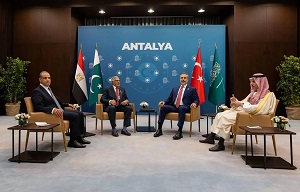 Abdelatty: Egypt Working with Pakistan on Lasting US-Iran Peace Plan
-
 Trump Hints at Resuming Attacks if Ceasefire with Iran Expires Without Deal
-
 Safadi calls for joint efforts to stabilise ceasefire in Lebanon