- Last Update23-Nov-2026


- Tweet
-
Prime minister reviews gov’t’s two-year achievements, outlines priorities for next phase
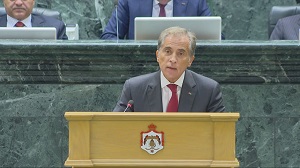
AMMAN — Prime Minister Jafar Hassan on Monday reviewed the government's achievements over the past two years and outlined its priorities for the coming period, reaffirming its commitment to advancing Jordan's political, economic and administrative modernisation tracks as a long-term national project that will shape the country's future for generations to come.
Addressing the Lower House, Hassan said that real economic growth reached 3 per cent in the second quarter of 2026, driven by strong performance in productive sectors and exports, while inflation stood at 2.32 per cent during the first 10 months of the year.
He also said that foreign direct investment increased by 25.1 per cent in 2025 to exceed $2 billion, its highest level in a decade, while total exports rose by 11.2 per cent during the first eight months of 2026. The Central Bank of Jordan's foreign reserves also reached record levels.
The prime minister highlighted progress on major strategic infrastructure projects, led by the $6.6 billion National Water Carrier project and the $2.5 billion Aqaba-Shidiya-Maan railway, being implemented in equal partnership with the United Arab Emirates. The foundation stones for both projects have been laid.
Studies for the Aqaba-Maan dry port are nearing completion, while development work is under way on the Risha gas field and a pipeline connecting it to the Arab Gas Pipeline, Hassan said, adding that tenders for the latter projects are scheduled to be awarded in April 2027, alongside tenders for the first phase of Amra City.
Hassan also cited the Jordan-Europe Investment Conference, held at the Dead Sea under Royal patronage, as evidence of strong international confidence in the Kingdom's investment environment.
In the energy and industrial sectors, he said that the government opened natural gas stations in southern Aqaba, Quweira, Qastal and Hashemiyeh, helping reduce energy costs for industrial facilities by between 35 and 60 per cent. Two additional stations, in Maan's Rawda Industrial City and Muwaqqar, are scheduled for completion in 2027.
“Incentives, including reduced land and energy prices in industrial cities in Karak, Tafilah, Maan, Salt and Madaba, attracted 34 new companies with investments exceeding JD62 million, expected to generate more than 1,000 jobs,” he said.
Through the Industrial Support Fund, 635 companies received support to improve their competitiveness, while 771 benefited from export assistance, he said.
“In agriculture, eight food-processing factories opened over the past two years, contributing to an increase of around JD160 million in the sector's contribution to gross domestic product in one year. The government also amended the Cooperatives Law and is preparing to host Jordan's first international exhibition and conference on irrigation and agricultural technologies.”
Despite regional conflicts, tourism contributed 12.6 per cent of gross domestic product in 2025, Hassan said, attributing the sector's performance to incentives for hard-hit destinations, including Petra, and continued support for low-cost carriers and Royal Jordanian.
He also highlighted several tourism projects, including the Jerash eco-tourism village, scheduled to open next summer, the Azraq eco-tourism oasis, expected to open next April, and upgrades to Afra Hot Springs in Tafilah, due for completion in late 2027.
On public finances, Hassan said the early submission of the 2027 draft budget would allow capital projects to begin at the start of the year. He noted that the government had settled JD1.3 billion in accumulated arrears inherited from previous years, while continuing efforts to contain public debt and gradually reduce budget deficits.
On political modernisation, the prime minister highlighted continued dialogue with parliamentary blocs and the passage of the Local Administration Law ahead of municipal elections scheduled for April 27.
“The law raises women's representation on municipal councils to at least 30 per cent and expands opportunities for the participation of young people and persons with disabilities.”
Under the administrative modernisation track, overseen by the National Council for Future Technology under the supervision of HRH Crown Prince Hussein, he said that the government has digitised more than 90 per cent of eligible public services and processed over one million digitally signed transactions.
“The Sanad application has issued approximately 3.5 million digital identities, while the number of comprehensive government service centres has increased from five to 16 across the Kingdom's governorates.”
Government responsiveness to Audit Bureau reports also improved, rising from 35 per cent in 2021 to a record 71 per cent in 2025. Hassan also pointed to human resources reforms and the establishment of the Jordanian Academy for Public Administration.
In response to parliamentary demands, the government approved a JD30 monthly salary increase, effective in 2027, for civil and military employees and retirees earning less than JD600. The measure builds on the 2025 increase in the minimum wage from JD260 to JD290.
Social protection programmes were also expanded, with 15,000 additional families enrolled in the National Aid Fund, bringing the total number of beneficiary families to nearly 250,000, he said.
“Allocations to the University Student Support Fund doubled from JD20 million to JD40 million, covering nearly 63,000 students. The government also settled JD80 million in outstanding student fund payments owed to public universities.”
In healthcare, he said that a JD124 million insurance programme launched at the King Hussein Cancer Centre in 2025 now covers more than 4.2 million citizens and is set to expand to an additional 300,000 in 2027. “Plans also include expanding the Samih Darwazah Cancer Centre at Al Bashir Hospital and establishing new cancer centres at Princess Basma Hospital in Irbid and in Karak in 2027.”
“Other healthcare infrastructure developments include the inauguration of the 500-bed Princess Basma Hospital in Irbid and the Digital Health Centre in Salt, as well as expansion projects at Princess Iman Hospital in Maadi, Maan Hospital and Prince Faisal Hospital in Zarqa.”
The Premier also said that the government also expanded outpatient clinics at Karak Hospital and completed the first phase of the new Madaba Hospital under a public-private partnership.
“In education, 252 school construction projects were completed over the past two years, out of 500 planned over five years. These included 120 new model schools and 132 classroom additions, with around 300 further projects planned for the coming years.”
The Ajyal and Siraj digital platforms, launched under the Future Technology Council, now serve more than 2.26 million students and 146,000 teachers, respectively, while the platforms have also expanded access to digital educational services to around 1.3 million users.
He said that a free school transport programme launched in the Southern Badia, serving 9,000 students and 900 teachers, is set to expand in February to additional areas in the Southern and Central Badia. The programme aims to serve 30,000 students in 2027.
In public transport, regular inter-governorate bus services have been introduced, while Amman's Bus Rapid Transit system has carried more than 78 million passengers cumulatively, he said.
“Routes connecting Amman with Madaba and Salt transported more than 600,000 and 460,000 passengers, respectively, during 2025.”
In the judiciary, amendments to the Penal Code, Criminal Procedure Law and Execution Law have sought to simplify litigation procedures, expand the use of community-based penalties and improve access to judicial services.
The government has also introduced 78 electronic judicial services, established 219 remote trial halls, linked the judiciary electronically with 26 entities and introduced digital signatures for all judges. Further judicial reform legislation is scheduled for 2027.
Hassan referred to recent terrorist incidents in Hmoud, Karak, and another attack that claimed the life of a Public Security Directorate officer.
He said that the government had submitted new draft laws to Parliament on Sunday to combat terrorism and extremist ideology and safeguard national unity, under the leadership of His Majesty King Abdullah and HRH Crown Prince Hussein.
Latest News
-
 Lebanon's Aoun slams Iranian influence, demands Israeli withdrawal
-
 US and Israeli Pressure Mounts on Trump to Resume Iran War
-
 Crown Prince to CNN: Investment conference a major milestone in Jordan-EU relations
-
 Trump, Xi and Putin's Pledge to Boost Refined Oil Product Supplies Faces Implementation Hurdles
-
 Gulf nations on alert after US strikes Iranian island